

The term entrepreneurship has been widely spread in the last ten years due to the dramatic increase in the number of startups launched during this period, as well as the great success achieved by a group of entrepreneurs in launching startups, which became major international companies in a few years, such as Facebook Inc., Amazon, Uber, and others.
In this article, we highlight the concept of entrepreneurship and entrepreneurs and review the most important pillars that give importance to this sector, whether at the individual, community, or economic level. We also discuss the startup lifecycle and its stages, the most important types of entrepreneurial projects, and the essential qualities entrepreneurs must have. Finally, we will refer to the major challenges facing the entrepreneurship sector.
Entrepreneurship
The term entrepreneurship refers to establishing a new institution or company based on an idea or a group of creative ideas, in addition to the constant willingness to develop this company and restructure its business.
Entrepreneur
The person who establishes the start-up company is called an “entrepreneur”, who has an idea that he believes provides a solution to a problem facing a specific group of people. Then he looks for a way to turn his idea into a successful project, striving hard to have the necessary tools to make his idea work. He also bears the risks he faces while applying his idea, and the entrepreneur is often characterized by creativity and innovation.
The importance of Entrepreneurship
The startups launched by the entrepreneurs contribute to a set of benefits, whether for the entrepreneur and those working in the startups on a personal level or on the level of society and the national economy. The most important of these benefits are summarized as follows:
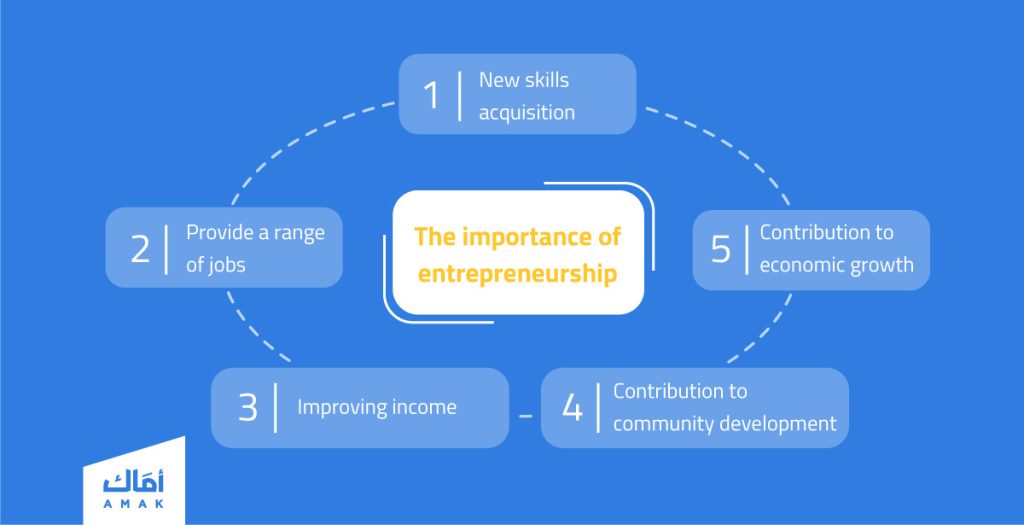
1- New skills acquisition:
Learning is one of the greatest benefits for an entrepreneur, as he is forced to wear different hats and acquire many skills beyond his field of work. He needs to practice a wide range of businesses, such as marketing, mastering sales, customer negotiation, money management, dealing with risks, effective time management and much more.
2- Provide a range of jobs:
Entrepreneurship provides various job opportunities for the entrepreneur and his employees. These jobs are useful for beginners to develop their skills through practical training.
3- Improving income:
Entrepreneurs aim to increase their income by launching their startups, which they will definitely have if they succeed and overcome obstacles.
4- Contribution to community development:
Entrepreneurs contribute to the development of society through the solutions they provide to existing problems or the development and modification of existing solutions, which supports creativity and innovation.
5- Contribution to economic growth:
Entrepreneurial businesses constitute a significant part of the national economy in many countries. They contribute to the development of the economy through new products and services that they provide to society, as well as through innovations that contribute to opening new markets and providing more opportunities in various employment sectors.
How does the Entrepreneur Get an Idea?
When discussing entrepreneurship and startups, the ideas adopted by entrepreneurs are the most crucial axis, as they are the first step and the basic block on which all parts of the business are built later. So, how do entrepreneurs get their ideas?
One of the essential qualities that characterize entrepreneurs is their creativity, which means that he is responsible for generating new ideas. That is done through their constant presence in the market, contact with people, examining the problems they face and thinking about solutions. Therefore, the entrepreneur must have insight and high analytical ability.
An entrepreneur is not always required to come up with a new idea that no one else has ever worked on. He can also imitate and replicate successful ideas in other environments to his. He can also make new adjustments to ideas of already existing projects and services to develop them and improve their performance.
Startup Lifecycle
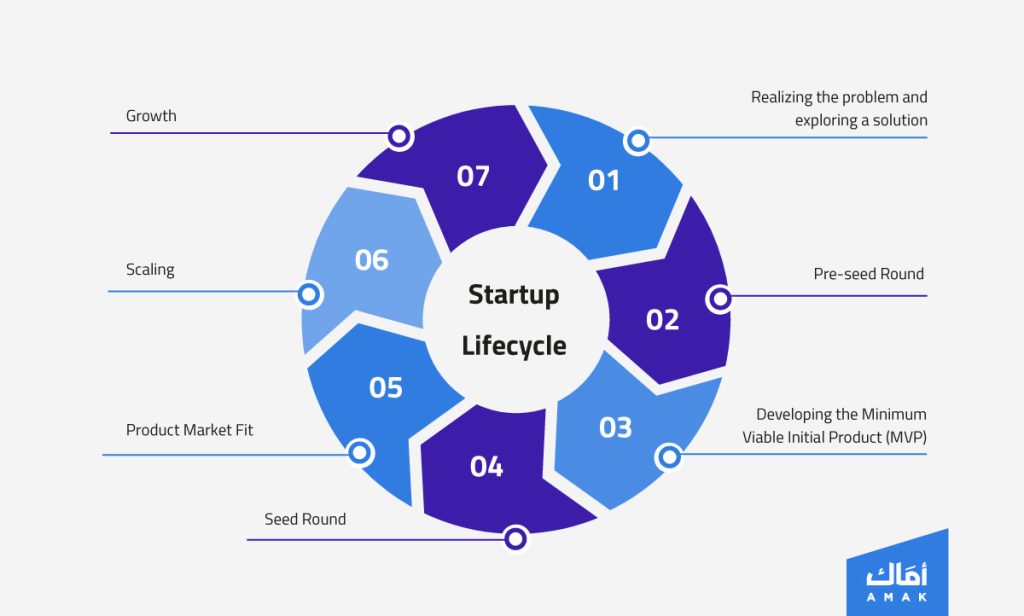
1- Realizing the problem and exploring a solution
This stage is crucial because all the following stages are mainly based on it. The entrepreneur at this phase should search for an existing problem and find a solution at the same time. He may find this idea as a result of a problem he encountered without even looking for it, and he must verify two questions:
- First: Does this problem really exist and face a specific group of people?
- Second: Does the entrepreneur’s solution really seem appropriate to this problem?
If the answer is “yes” to both questions, the entrepreneur will start the second stage.
2- Pre-seed Round
Most startups go through this stage, in which the entrepreneur has to risk many things, including his fixed or current job and some of his own money and savings. At this stage, the entrepreneur must directly engage in applying his idea to the ground through the initial product, which requires him to invest his or his family’s money. Because investors do not pay for ideas, it is not possible to get financing from an external investor at this stage.
3- Developing the Minimum Viable Initial Product (MVP)
At this phase, the entrepreneur must test the validity of his hypothesis regarding the idea he proposed to solve the existing problem. This is done by building the minimum applicable product with the least possible investment of time and capital. In this way, he can ascertain the acceptance of the idea and recognize the customer’s behaviour, while minimizing the risk to the lowest possible level.
4- Seed Round
This phase begins after the success of the MVP, where startup investors and the products or solutions they offer are sought. During this financing round, the entrepreneur must prove to the expected investors that his idea has already succeeded through data indicating customer interests and achieved revenue and that his product is ready to move to a higher level.
5- Product Market Fit
If the entrepreneur could get funding for his product, and the product makes qualitative leaps in the number of those interested in it and a steady growth in the number of customers who repurchase it, then he becomes able to develop the product to a higher level than the initial product. He starts designing a product suitable for the market that meets the needs of a larger category of customers, and at this stage, the startup begins to achieve rapid growth.
6- Scaling
If the entrepreneur is sure that his company has reached a steady growth point, he can start the expansion stage by employing experts in sensitive departments of the company, which can achieve more growth in sales and profits, as well as by dealing with a larger group of companies and suppliers and trying to obtain large-scale investments.
7- Growth
If the entrepreneur successfully passes the previous stages, and his startup becomes well-established in the market, he will be able to look for more growth opportunities, either by developing more solutions or products or by searching for acquisition offers from large companies that can transfer the startup to advanced levels and entirely new markets.
Entrepreneurship & Business Incubators
Many people interested in the field of entrepreneurship have begun to establish what is known as business incubators that attract ideas and innovators to support them in implementing their ideas and launching their startups. Business incubators consist of programs specialized in helping entrepreneurs succeed in their ideas by providing a range of services, including training and networking with experts and assistance in finding investors. The incubation process often proceeds according to the following stages:
- Applying to the incubator program by the owners of ideas interested in turning their ideas into products on the ground.
- Training accepted members on the most important skills they need in entrepreneurship, such as marketing, sales, negotiation with suppliers and customers, and essential technical skills in the labor market.
- After completing the training phase, the business will be presented to an evaluation committee to select the successful projects that will move to the second level.
- At the second level, the owners of accepted projects are networked with the most important entities in their field of work. Most incubators also give financial prizes to those who are accepted so that they can develop their businesses more quickly. Expert mentors are also allocated to accompany the owners of projects in the first stage of their work to provide them with the necessary advice about overcoming the obstacles they face.
- The final phase of acceleration begins, as investors are often contacted at this stage to finance the most successful projects so that entrepreneurs can make qualitative leaps and accelerated progress in their work.
The essential Traits of an Entrepreneur
An entrepreneur must have a set of characteristics that qualify him to engage in the entrepreneurship sector, the most important of which are:
- Innovation and creativity
- Passion and dedication to work
- Risk tolerance
- facing failure
- Self-confidence and self-motivation
- competitive
- Effective communication skills
- Continuity in work
The Most Important Types of Entrepreneurship
Entrepreneurial businesses are classified according to the diversity of ideas that entrepreneurs have and the sectors in which they work. However, there are four main types of entrepreneurial businesses:
1- Small entrepreneurship
This type expresses the small businesses launched by their owners to achieve acceptable and sufficient profits to meet their living needs, and they often have no intention of expanding. Examples of this type include small shops such as groceries, hairdressing salons and small shops selling handicrafts, etc. In this type, entrepreneurs often invest their own money and do not resort to outside investors.
2- Scalable startup
This type expresses companies that start with unique and innovative ideas, and often the ideas of these companies represent technical solutions. These companies seek to expand greatly, so they need investors and significant capital to move to higher levels of work and be present in more markets.
3- Entrepreneurship in large companies
Existing large companies have become interested in the entrepreneurship sector due to the huge expansion it is witnessing. As a result, so many large companies are trying to create a department dedicated to entrepreneurship so that it searches for problems and solutions and launches affiliated startups of large companies to offer new products.
4- Community Entrepreneurship
Community entrepreneurship aims to provide solutions to society and people but it does not aim for profit, such as businesses that care about the environment, public utilities, health, and so on.
Entrepreneurship Challenges
Entrepreneurs are exposed to many challenges because they work in an emerging sector, so they must consider these challenges when thinking about launching their startups. The most important challenges facing many entrepreneurs are:
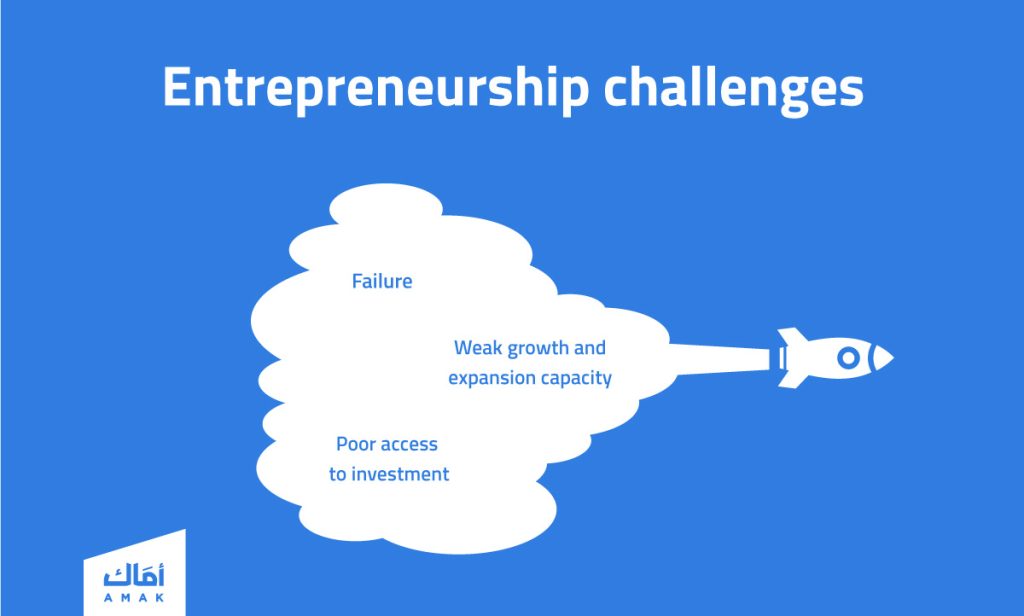
1- Failure
According to a wide range of statistics, most entrepreneurial projects and startups fail at a rate of nearly 90 percent because entrepreneurs launch their projects based on uncertain initial assumptions. Therefore, the entrepreneur must come to terms with the possibility that the idea he is working on may fail and always be ready to switch to a new one or modify the products he offers after testing them on the ground.
2- Poor access to investment
Investors only provide financing for a startup if they are confident that investing in this company will bring them great profits worth the risk. Therefore, most entrepreneurs do not find investors or sources to finance their ideas, which requires them to search for alternative ways of financing.
3- Weak growth and expansion capacity
Some businesses may succeed in launching, acquiring customers, and making profits but not necessarily grow and move to wider ranges of customers and markets. The entrepreneur must understand his product well, and understand the market and customers to expand his startup.
In conclusion, the widespread entrepreneurship and the presence of many ambitious ideas are not enough to start delving into this field. There are many obstacles and challenges facing entrepreneurs, and we have mentioned the most prominent of them in this article. What requires them to undergo intensive training in this field, rearrange their ideas, enjoy the openness and benefit from the experiences of others, and not risk their work, jobs, or even their money before forming good knowledge that makes them widely knowledgeable in this field.