
The business model has become necessary for many entrepreneurs, with many companies adopting the entrepreneurial method to provide outstanding performance that outperforms competitors. The business model is the primary guide for entrepreneurial companies, enabling them to achieve the goals they aspire to reach.
In this article, you will learn about the concept of a business model, its outline, and its importance. In addition to a detailed explanation of its types and the main components of the business model adopted by commercial companies. After reading this article, you can choose your business model and start your project more confidently.
What does Business Model Mean?
The business model is a strategy to study the quality of ideas before implementing them and turning them into a commercial project on the ground. It helps entrepreneurs think more consciously about all the elements of success required to establish a successful company.
Importance of the Business Model
The business model is the main pillar of the commercial project that the company relies on to determine the working mechanism and reach all the goals it seeks. Besides, it offers investors a better understanding of the project’s competitiveness by providing them with a clear vision of the company and its activities.
The business model benefits are summarized in the following points:
- Determines how the company innovates, achieves, and utilizes its value.
- It is a measuring tool for the feasibility of the project idea before preparing a detailed study.
- Helps to modify and develop project elements.
- Provides a complete evaluation of the project.
Model Business Types
Your knowledge of business types is of great importance to the success of your project. Defining the project template gives you a clear view of the nature of your business. In this paragraph, we explain the most prominent of these types:
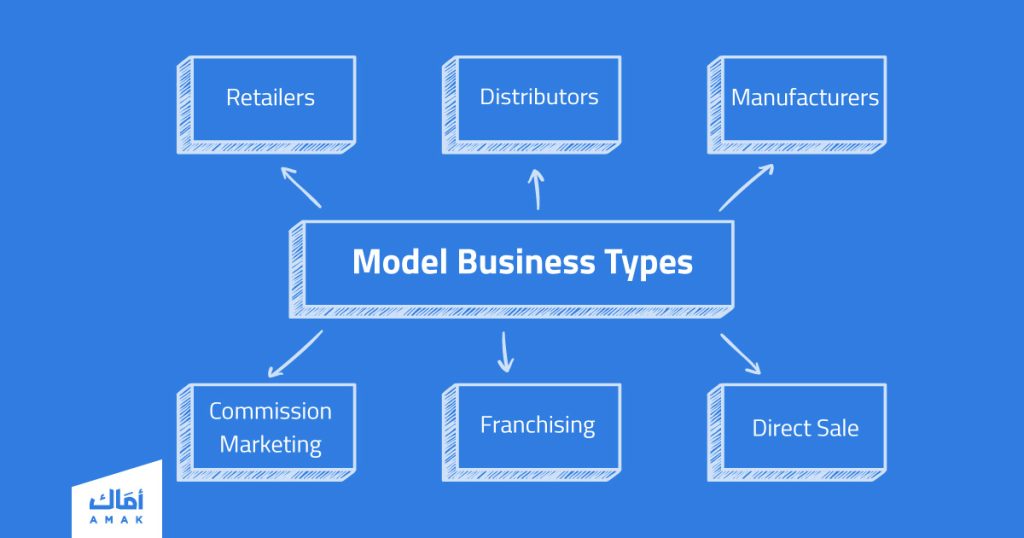
- Manufacturers: Those who manufacture final products.
- Distributors: A distributor buys from a manufacturer and resells the products to retailers or customers.
- Retailers: Retailers are the last link in the chain of commercial activity.
- Direct Sale: Selling from the manufacturer to the customer without intermediaries.
- Franchising: The most common commercial business model. It is a fixed business scheme purchased and reproduced by the buyer. Both the franchisor and its owner cooperate in providing the necessary financing and marketing in exchange for the grantor obtaining an agreed share of the profits.
- Commission Marketing: This type depends on marketing other people’s products in return for a commission for each sale made by the marketer.
Difference between a Business Model & a Business Plan
The success of any business depends on two main pillars: the business plan and the business model. To avoid confusing them, we will explain what these terms mean.
The business plan is a document that includes all information related to the company’s strategy, methods of implementation and financial expectations over the next several years as evidence presented by the company to lenders, banks or investors of its presence in the market as a successful company. Business Plan is the fundamental pillar of all marketing, financial planning and activities carried out by the company.
The business model provides a comprehensive description of the steps and the mechanism the company follows to create value, how it achieves this value, for whom it provides this value, and how it will achieve its profits. It’s significant because it helps you – as an entrepreneur – develop your strategy for acquiring customers, identifying the best partners for your business, and developing your business.
Why does a Business Model Fail?
Companies sometimes fail due to a defect in the business model they apply. In this article, we will mention the four most significant mistakes made by companies, which led to their failure; To avoid them in your business model and increase the chance that your business will succeed.
Four mistakes in the business model:
1- Solving issues unrelated to the target customer:
When you develop your company’s business model that does not solve a real problem for the customer, your model fails to achieve the company’s primary goal of adapting the product to the market. The continuity of any business model can only be achieved by achieving this goal. To avoid making this mistake, focus – in the first place- on what your customer suffers from, his problems, and the gains he seeks to obtain instead of only caring about the product and developing its features.
2- Developing the wrong business model:
If you set the wrong business model your company will not succeed, even though you provide the right value that your customer is looking for (for example few people know that Kodak helped invent the digital camera which is the reason failure of the Kodak Model). In this case, the mistake Kodak made in its business model is that its value proposition resulted in producing a new product at a greater cost than Kodak’s revenue from its customers.
This mistake occurs when you select the wrong profit model, incorrectly determine the price value, or misestimate the costs involved in the business activities, resources, and partnerships needed to create your value proposition. Also, failure may occur because you fail to identify the proper channels to reach your customers and deliver your value to them.
3- Omitting external threats in the business model environment:
Ignoring external threats, most notably your potential competitors, will not guarantee that you solve your client’s problems or make an appropriate business model; instead, it will prevent you from having a successful business model. You may fail to reach your customers because of the intense competitors and their use of a business model that blocks them from you (imagine, for example, competing with Apple).
It’s not only about competitors, but the constant change of your customers’ needs and problems is one of the most important threats you have to pursue and monitor to stay up-to-date on any change that happens to make the necessary adjustments to your business model as quickly as successful companies do.
4- Bad execution:
Am I doing my model the right way? Does everything in the company of resources, capital, employees and technology work together to achieve one goal? If you don’t employ them all to work in harmony, it will cause your business model to fail.
So, to avoid this mistake, make sure to continuously monitor and measure the performance of all relevant factors, through which you can ensure compatibility and harmony of all aspects with the business model’s goal.
Business Model Elements
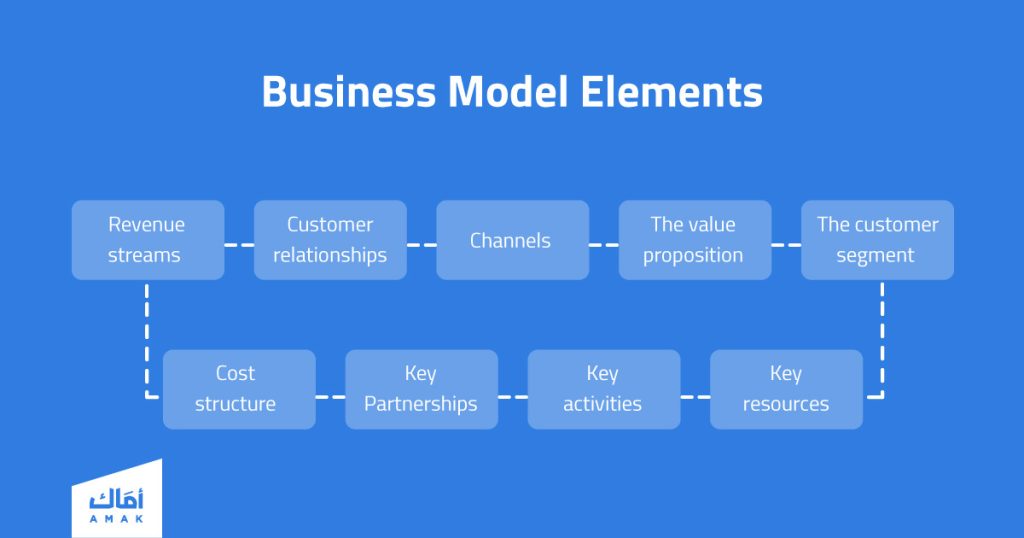
1- The customer segment:
It is the category you target in your business and maybe one or several segments. It is divided into:
- Individual Segments B2C: You directly target your customers as if your business is to provide ready meals to individuals.
- Companies Segments B2B: You provide your services to institutions and companies. As in the previous example, you target companies to provide them with ready-made meals in addition to your services.
2- The value proposition:
includes the value you will offer your target segment. The higher value and benefit you provide, the higher the chance your project will succeed.
3- Channels:
They include all the ways and means you will use to access your segment and provide your services.
4- Customer relationships:
This element represents how the company deals with its customers to achieve a unique customer journey with the company by identifying common points and communicating with customers through multiple communication methods such as social media or customer service.
5- Revenue streams:
What are the best ways and sources to generate revenue for you? Selling the product is no longer the only means of doing so. Determine the sources that will bring you the required return, such as advertisements or fees.
6- Key resources:
To launch your project, you need a set of basic resources divided into human resources such as workers and experts, material resources such as raw materials, production lines, and machinery, as well as moral resources such as licenses, trademarks, or sometimes patents.
7- Key activities:
The importance of commercial activities is that achieving the value proposition comes from recycling and forming the main resources through the implementation of basic activities represented in production operations, problem-solving processes, and finally, defining the platforms on which you will carry out your activity.
8- Key Partnerships:
Any commercial project in the labour market must communicate and network with parties that help it achieve its goals, such as the external parties the company needs to complete the company’s service work and achieve the value proposition for the customer. The simplest form of such partnerships is contracting with suppliers.
9- Cost structure:
The cost structure refers to the total cost the company needs, and its value is linked to the activities required to implement the project.
What is a Business Model Canvas?
Business model canvas means how the main components of the business model are represented visibly facilitates work and is an ideal method for startups. Its importance for the business is that it assembles all the business details in one place, assessing the strategy, identifying potential weaknesses and risks, and other essential matters.
You can use several models to help you achieve your goals by covering all the tasks and responsibilities that your business requires. Of course, you don’t have to use these models, but it is recommended to rely on them during work for their work-level benefits, such as:
- Detect and cancel unnecessary tasks.
- Improve work efficiency by highlighting and optimizing glitches.
- Ensure that operations are replicated with the same efficiency and effectiveness even as new members join the team.
Here I will list two commonly used business model schemes you can use:
1- Business Process Modeling Notation (BPMN)
It is based on the use of symbols to represent the workflow and the tasks to be performed, and these symbols are one of the following forms:
Flow objects:
They are divided into three major components:
- Events: Indicates the events that occur during the operation process, and affect the workflow, and are represented by circles.
- Activities: represented by rounded rectangles, indicating tasks and sub-processes.
- Gate and control points: used to control the process and are indicated by the diamond symbol.
Connecting objects:
Responsible for connecting flow objects to form the business structure and is divided into:
- Sequence flow: Solid arrows are used to indicate the order in which the phases are executed.
- Message flow: Represented by the intermittent hollow arrows to indicate the correspondence among participants in the business process.
- Conjugation: The dashed-dotted line indicates the active inputs and outputs.
Swimlane flowchart:
Sub-processes in the workflow that require the participation of several entities. This chart shows the distribution of responsibilities between the participating entities and how they interact. Where the passages express the individuals or entities involved in the implementation.
Artefacts:
Express the information added to the diagram for illustrative purposes of the process, not resulting from the operation’s progress. It is represented by the dashed lines, which indicate the points this information refers to.
2- Process Flowcharts
This model is one of the most popular and easy-to-use business model schemes. It is based on a step-by-step representation of the process in the way you think fits you; There is no specific template, but the aim is to represent the process in the simplest possible and easy-to-understand manner. You can do it through one of these ways:
- The traditional way, using paper and pen.
- flowchart software.
- workflow management software.
What is the Best Business Model for a Startup?
Now you might be wondering: How do I choose my company’s best business model to adopt? Of course, you have all the right to this question which we are discussing in this paragraph.
Before turning your idea into a project based on reality, you have to ask yourself several questions to which your answers will be the compass that will accurately guide your activity and help you choose the appropriate business model for your company.
When making a decision, you should consider the following aspects:
1- Target Market:
First, you need to test the applicability of your idea. Research the market you are targeting to get an idea of your customers. Make sure that what you intend to provide meets their needs and demand, and make the necessary modifications to your service in light of the information you get.
2- Competition and Competitors:
When you actually enter the market, it is necessary to get to know your competitors and the number of those who provide your service, study their experiences and the reasons for their success and failure to learn from them, and then think about what you can do to outperform them and the added value that you can provide.
3- Potential Customers:
Although the information you have is insufficient to depend entirely on, except before you have been in the market for a while, it helps you form a mental perception of your ideal customer: Who is he? What problems does he suffer from? What are his goals? You can use Client personality in building your potential customer personality.
4- Revenue Sources:
The essential point to your decision is your primary source of revenue. Still, you must consider additional sources that increase your revenues, such as selling other products and services in addition to your main product or commission marketing. Always look for options to boost returns and profits, not be limited to one source.
In conclusion, whatever your business type is, the business model will help you plan your activity strategically, drawing up a clear roadmap that will increase your project’s chances of success. The business model helps to sustain your business by constantly developing your services. Now, after reading this article and understanding the concept of a business model, you can begin to transform your entrepreneurial idea on a solid basis, and the door is open for you to turn it into a successful project.